



 Last minute booking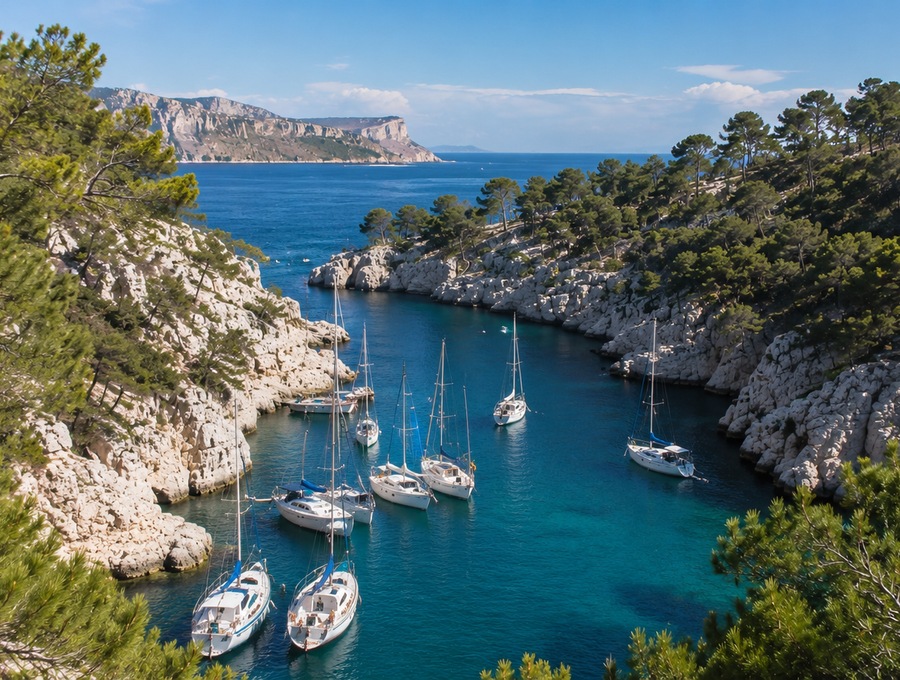



At the eastern end of the Calanques National Park, the Port-Miou calanque stretches for 1,400 metres between two white cliffs, where 550 sailing boats are moored. Three features set it apart from the others: it is the only calanque in the municipality of Cassis, it is home to one of Europe’s largest underwater karst springs, and it has served as a safe harbour since ancient times, under the Latin name Portus Melior, ‘the best harbour’. All the more reason to include it in your sightseeing itinerary during your stay at our campsite near Marseille!
Key points to remember
- The Port-Miou cove stretches for 1,400 metres to the east of Cassis.
- Its marina is home to nearly 550 boats in deep blue brackish waters.
- One of Europe’s longest underground rivers feeds the site.
- You can get there by car or on the Gorguettes shuttle bus.
- A signposted coastal path links Port-Pin and En-Vau from Port-Miou.
A cove shaped by human activity since ancient times
Port-Miou has neither a beach nor a cove: it is a natural harbour nestled between two white cliffs. Furthermore, three successive periods have shaped its present appearance.
1. Antiquity: a safe harbour known as Portus Melior
Sheltered from the mistral, the calanque has been used as an anchorage since ancient times, under the Latin name Portus Melior, meaning ‘the best harbour’. Roman ships and medieval galleys used to call here.
2. The Solvay career (1896–1981)
In 1896, the Belgian industrialist Ernest Solvay opened a quarry there to extract Urgonian limestone, which was crushed on site to produce caustic soda. Over the course of 85 years, 6 to 7 million tonnes of rock were extracted, shaping the cliffs we see today.
3. Today: a marina with a capacity of 550 boats
Now converted into a marina, Port-Miou is home to 550 boats. The former Château Solvay now serves as the harbour master’s office, and the site is one of the gateways to the Calanques National Park.
The hidden secret: an underground river beneath the cove
Beneath the limestone of Port-Miou flows one of Europe’s longest underground rivers. Specifically, according to the Calanques National Park, around 7 m³/s of fresh water flows into the sea at the mouth of the calanque, fed by a catchment area of over 400 km² that extends as far as the Sainte-Baume massif.
To unravel the mystery of this resource, an artificial tunnel was dug in the 1970s leading to the underground gallery, 500 metres from the shore, and completed in 1976 with a dam that now allows the flow and salinity to be monitored continuously.
One major obstacle remains: the water, which is brackish due to contamination from upwelling deep seawater, remains unusable. If this obstacle could be overcome, it could supply part of Lower Provence with drinking water!
4 experiences to enjoy at the Port-Miou calanque (and nowhere else)
Beyond a simple swim, there are certain experiences that can only be had at Port-Miou Cove! Here are four activities that make the most of the area’s unique features.
- Listen carefully at the ‘blowhole’: between Port-Miou and Port-Pin, a partially submerged geological fault compresses the air under the pressure of the waves, emitting a whoosh that can be heard from the footpath. The phenomenon is most pronounced on days when there is a swell.
- Look out for the remains of the Solvay quarry: as you walk along the path, you’ll pass the hoppers (stone chutes) at the edge of the quay, the former Solvay castle (staff accommodation that has since become the harbour master’s office) and the marks left on the cliff face by quarrying.
- Paddle to Port-Pin: whether by kayak or stand-up paddleboard, you’ll travel along the limestone cliffs for around 20 minutes until you reach this nearby cove, which has a small sandy and pebbly beach surrounded by Aleppo pines.
- Complete the Little Prince trail at sunset: this 1.7 km loop (30 mins, easy) around the headland offers panoramic views of the calanque and Cap Canaille, away from the daytime crowds. Its name pays tribute to Saint-Exupéry, whose plane crashed off the coast of Cassis in 1944.
How do you get to Port-Miou from your campsite?
The Youcamp Village – Marseille Provence campsite in Aubagne is about a 20-minute drive from Cassis. There are then three routes you can take to reach the Port Miou calanque.
- The quickest route: from the centre of Cassis, Avenue Notre-Dame leads to the Presqu’île car park in about ten minutes. Expect to pay €8–10 for a day’s parking in high season, and try to arrive before 9 am; the car park fills up by mid-morning.
- The most economical option: park for free at the Gorguettes park-and-ride car park (220 spaces, at the entrance to Cassis), then take the 373 shuttle bus to the Presqu’île; a return ticket costs €1.60. Service operates during the season.
- The best part: from the centre of Cassis, follow the GR 51 and GR 98 trails for about 30 minutes to reach the calanque along the coast.
Once there, the west-bank path continues the walk to the nearby cove of Port-Pin, a 25-minute walk away.
Fancy exploring Port-Miou and its nearby rocky coves from a campsite with a strong focus on nature? Book your stay at Youcamp, where your mobile home rental in Marseille is just around 30 km away!
Sources :
- Parc national des Calanques – La rivière souterraine de Port-Miou : https://www.calanques-parcnational.fr/fr/la-riviere-souterraine-de-port-miou
- Eaufrance Rhône-Méditerranée – Système karstique des sources de Cassis : https://rhone-mediterranee.eaufrance.fr/systeme-karstique-des-sources-de-cassis-port-miou-et-bestouan
- Mairie de Cassis – Port-Miou : https://www.cassis.fr/gerer-mon-quotidien/environnement-et-nature/port-miou
- Office de tourisme de Cassis : https://www.ot-cassis.com